
A failing house connection
A ledger held with nails, missing flashing, or soft wood behind the ledger board. This connection is where the most serious deck failures start, and it cannot be patched from the outside.
Tear-out and rebuild · Atlanta, Georgia
When an old deck is past repairing, we remove it, fix what it was hiding at the house wall, and build a new one on proper footings. When the frame still checks out, we tell you and replace only the surface.
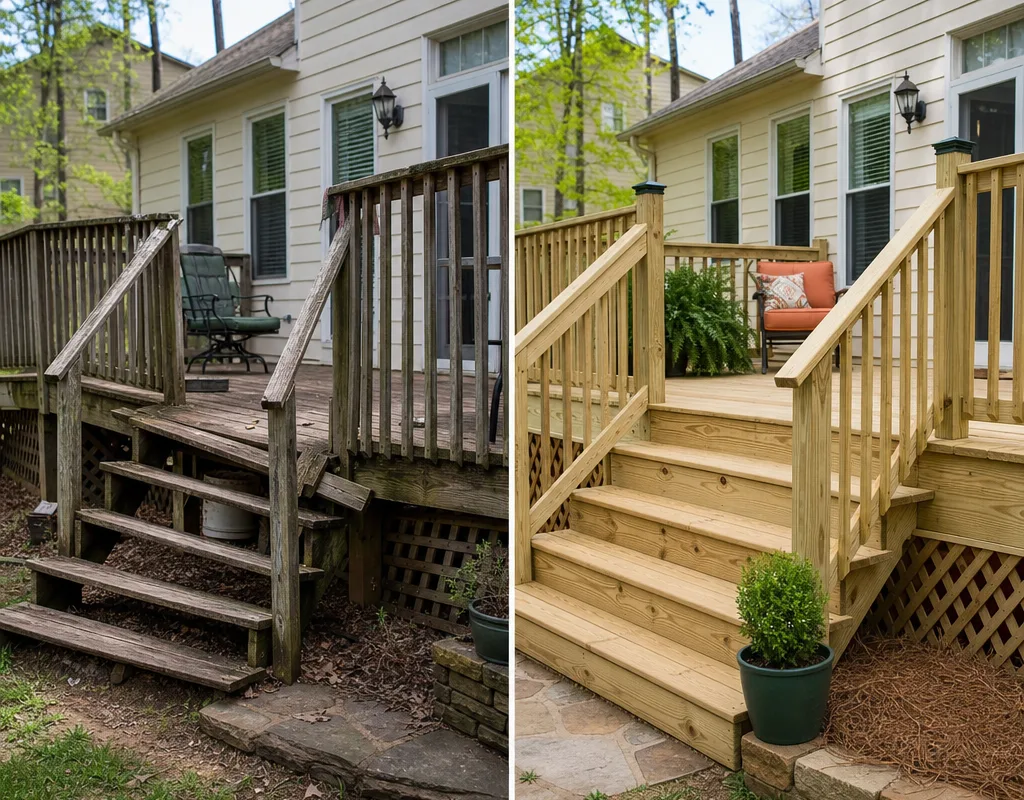
Repair, resurface, or rebuild
Most decks wear out from the bottom up. The boards you see may look tired but serviceable while the parts that carry the load are failing: the ledger where the deck meets the house, the joist ends, the beam connections, and the bases of the posts.
This region is hard on those parts. Long humid summers and frequent rain keep shaded framing damp, and building departments in north Georgia rate the area as severe for wood decay and very heavy for termites. Many older decks were also built before current rules for ledger attachment and guard strength, with ledgers nailed instead of bolted and no flashing behind them.
A full replacement makes sense when the damage is in the structure, when the deck was under-built to begin with, or when you want a size, height, or layout the old frame cannot support. It is one part of the full range of deck services in Atlanta we offer, and we will tell you plainly if a repair would do the job instead.
Signs we look for
A ledger held with nails, missing flashing, or soft wood behind the ledger board. This connection is where the most serious deck failures start, and it cannot be patched from the outside.
If a screwdriver sinks into several joist ends, or the beam is soft where it bears on the posts, sistering a few boards will not restore the frame.
Posts buried in soil or set in concrete often rot at grade, where they stay wet. Leaning posts, or posts you can dent at the base, need replacing with posts on proper footings.
A deck that sways when people walk, or rails that give when you lean on them, usually points to undersized framing, long spans, missing bracing, or loose connections throughout.
Low guards, wide baluster gaps, uneven risers, and no graspable handrail are common on older decks. Bringing them up to standard often means rebuilding them.
When boards, rails, stairs, and several framing members all need work, the cost of repairs approaches the cost of a new deck that carries no old problems forward.
Two ways to replace
There are two versions of deck replacement, and the inspection decides which one applies.
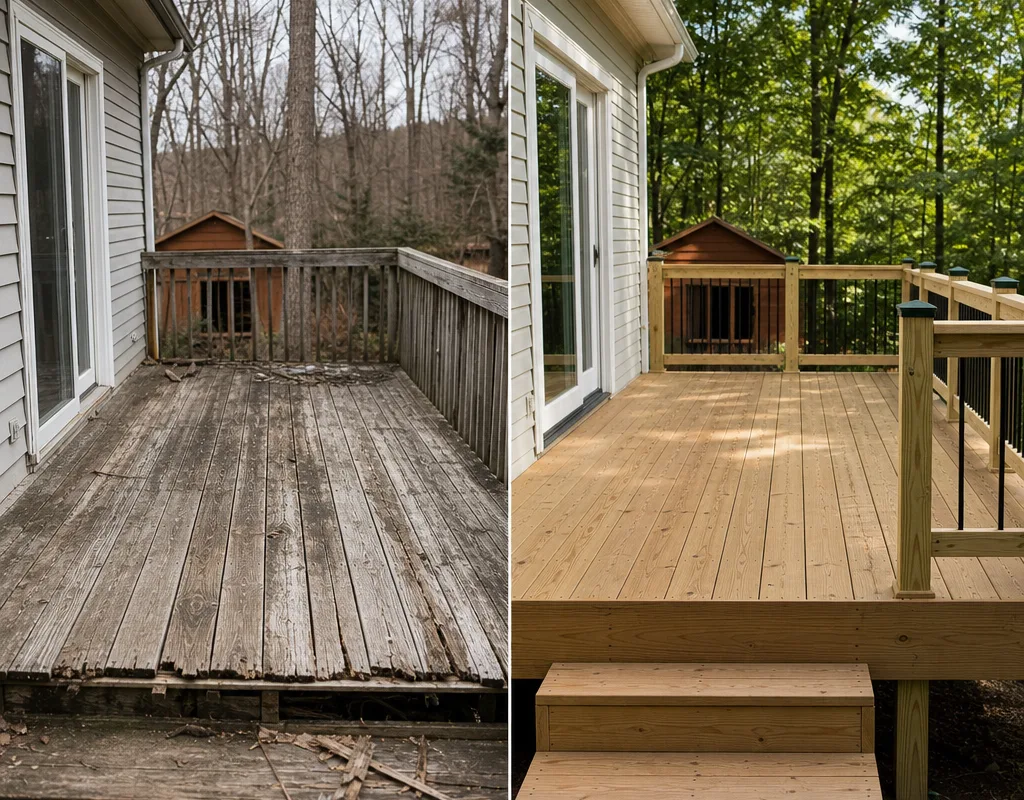
Resurfacing keeps the existing frame and replaces the decking, and usually the rails and stair treads. It costs less and takes less time. It only makes sense when the ledger, joists, beams, posts, and footings are sound and the joist spacing suits the new boards.
A full rebuild removes everything down to the ground and starts with new footings. A typical scope includes:
We do not reuse old footings unless we can confirm their size and depth, because what is under the ground is usually the least documented part of an old deck.
Planning your budget
Replacing a deck costs about what a new one does, plus demolition. Most deck builds in Atlanta fall between about $6,000 and $25,000+, depending on size, height, and materials. Tear-out, haul-off, and any repairs at the house wall are added to that.
Resurfacing a sound frame costs less than a rebuild because the footings and framing stay. The price moves most with square footage, decking material, railing length, stairs, access for removing debris, and how much hidden damage shows up once the old deck comes off. The exact cost is confirmed after an on-site look and a written scope.
Step by step
We check the ledger, framing, posts, footings, stairs, and rails, and tell you whether repair, resurfacing, or a rebuild fits.
We confirm whether the new deck keeps the same footprint or changes size, height, or stair location, then put materials and inclusions in writing.
A rebuilt deck that is attached or elevated typically needs a permit. We guide you through the permitting process and plan the work around inspections.
The old deck comes down and is hauled away. We open up the house connection, repair any damage, and flash it before the new ledger goes on.
New footings, frame, decking, stairs, and rails go in, with cleanup at the end of each day.
We walk the finished deck with you and go over care for the materials you chose.
Not sure what is under the boards? Have the structure checked first.
Call (470) 279-4199Common questions
It varies with exposure, materials, and upkeep. A pressure-treated deck that is cleaned and sealed regularly and built with good flashing can last decades, while one in deep shade with trapped moisture and no maintenance can have structural rot much sooner. Age matters less than the condition of the ledger, joist ends, and posts.
Only if they can be verified. We need to know a footing's size and depth and see that the post above it is sound and held off the ground. Posts buried in soil or concrete are usually replaced. If the new deck is larger or higher than the old one, the footings generally need to be new.
A full rebuild is new structural work, and attached or elevated decks typically need a permit and inspections. In the City of Atlanta, permits go through the Office of Buildings, and applications that may affect trees require an arborist meeting before they are submitted. Replacing boards alone on a sound frame is usually treated as maintenance. We confirm what applies to your address before work starts.
Yes, and replacement is the time to fix what never worked: stairs in the wrong place, a deck too shallow for a table, or a door that opens onto a step. Changes to footprint or height are checked against the setback and lot coverage rules for your property.
Tear-out is usually done in a day or two. A simple rebuild often takes one to two weeks of on-site work after that, and longer for elevated or multi-level decks. Permit review, inspections, weather, and material lead times affect the start and finish dates.
We take it apart, load it, and haul it off as part of the scope. Treated lumber should not be burned, so it goes to an appropriate disposal site.
Service area
We take on this work throughout Atlanta and in nearby cities, including Sandy Springs, Brookhaven, Dunwoody, Vinings, and Marietta.
Know before you spend
Tell us how old the deck is and what you are noticing. We will check the structure, explain whether repair, resurfacing, or a rebuild makes sense, and put the plan in writing.