
Pressure-treated wood
The most affordable option and easy to match on an existing wood deck. It needs staining or sealing along with the deck, and the balusters and rails should be checked for looseness each year.
Rails, guards, and stairs · Atlanta, Georgia
Railings and stairs are the parts of a deck people lean on without thinking. We build and replace them to current height, spacing, and strength requirements, in a style that suits the house.
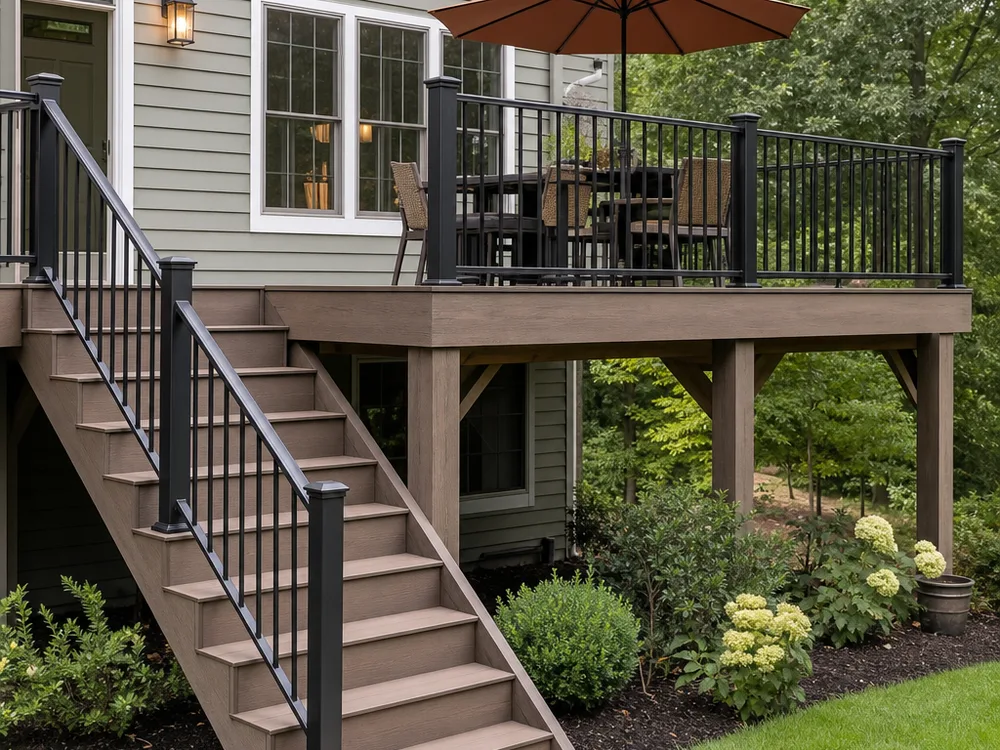
Safety you can see
On most older decks, the rails and stairs wear out before anything else. Posts work loose where they bolt to the rim, balusters split, stair stringers rot where they meet the ground, and treads cup and turn slick. These are also the parts a home inspector or a buyer looks at first.
We install railings and stairs on the decks we build, and we replace them on existing decks when the frame underneath is sound. Before quoting a replacement, we check the rim joist and the stair attachment points, because a new rail is only as strong as what it is bolted to.
On a new deck this work is part of our deck building and repair services. On an existing deck it can be a stand-alone job.
Railing options
The most affordable option and easy to match on an existing wood deck. It needs staining or sealing along with the deck, and the balusters and rails should be checked for looseness each year.
Powder-coated posts, rails, and balusters that do not rust or need paint. Slim profiles keep sightlines open, and black or bronze works with most decking colors.
Horizontal stainless cables between sturdy posts for the most open view. The posts and frame must be stiff enough to hold cable tension, so this system is planned with the framing.
Sleeved posts and rails that match composite decking and clean up with soap and water. Bulkier than metal, with a traditional look.
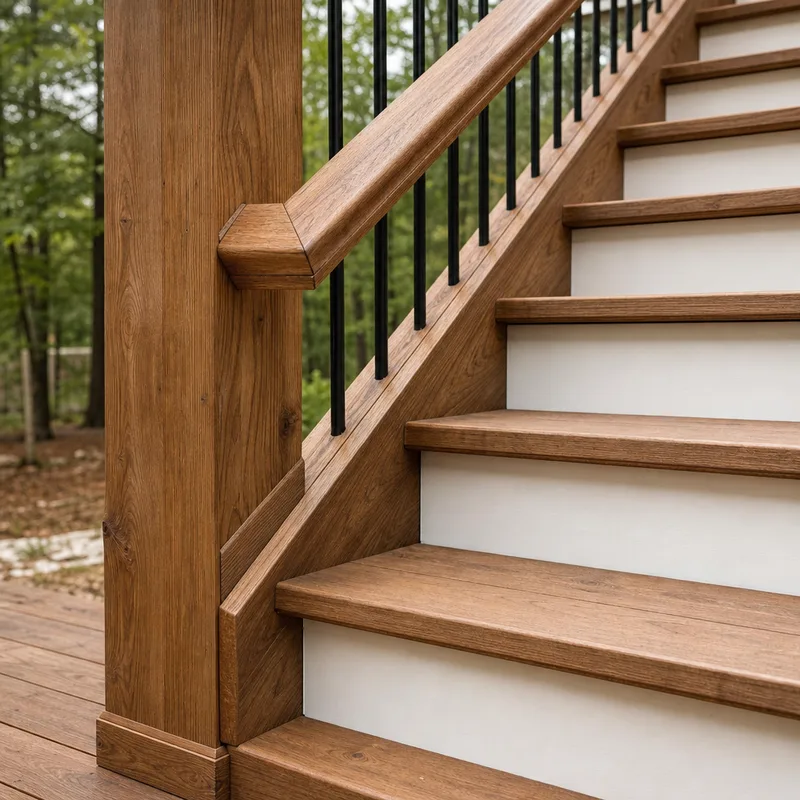
A common middle ground: wood posts and top rails with round or square aluminum balusters that never need painting.
Self-closing gates at stair openings for children and pets, plus low-voltage post cap and stair riser lights for safer steps after dark.
What the code asks for
Georgia's residential code is based on the International Residential Code with state amendments, and local building offices enforce it. For a typical home deck, the main requirements are:
Some neighborhoods and historic districts also limit railing style or color. We confirm the rules for your address before finalizing the design.
Planning your budget
Railings are priced mostly by length and material, and stairs by the number of steps and whether a landing is needed. Pressure-treated wood rail costs the least. Aluminum and composite systems cost more, and cable is usually the highest because of the hardware and the stiffer posts it needs.
Small repairs such as a loose rail section, a few balusters, or replacement stair treads typically run about $350 to $1,500. Replacing all the railing on a deck or rebuilding a full stair run costs more and depends on height, length, and material. We confirm the price after a site visit, in a written scope.
Step by step
We look at the rim joist, existing post attachments, stringers, and the landing at the bottom of the stairs.
You pick material, color, baluster style, and any gates or lights. We confirm it meets the height and spacing rules for your deck.
Rail length, post count, stair layout, and removal of the old parts are listed in writing.
Posts are blocked and bolted to the frame, rails and infill go on, and stairs are built on solid bearing at top and bottom.
We test every post and handrail with you before we call the job done.
A railing that moves when you lean on it is a safety problem.
Call (470) 279-4199Common questions
Yes, if the frame is sound. New posts need solid blocking and a rim joist that is not split or rotted. We check that first, and if the rim needs repair we include it in the scope.
Under the residential code used in Georgia, a guard is required when the walking surface is more than 30 inches above the ground. Many homeowners add a rail on lower decks anyway for comfort, or to keep furniture and children away from the edge.
They are widely used on residential decks, and the same 4-inch opening limit applies, which controls cable spacing and tension. Some HOAs and historic districts restrict modern rail styles, so check your covenants before ordering.
Usually because the ground or landing at the bottom has settled, or the stringers were cut for a different height. Uneven risers are a trip hazard. The fix is often new stringers on a proper landing pad, not shims under the old ones.
Like-for-like repairs are often treated as maintenance, while rebuilding stairs, moving them, or altering guards can require a permit. It depends on the jurisdiction and the scope, so we confirm with the building office for your address.
Service area
We take on this work throughout Atlanta and in nearby cities, including Sandy Springs, Brookhaven, Dunwoody, Vinings, and Marietta.
Safe to lean on
Tell us what is loose, worn, or missing, or what look you want on a new deck. We will check the structure, show you options, and give you a written scope.